Tuesday, October 23, 2012
Niquette Bay of the Past

Managment of our Site
Our hectare was an excellent representation of the type of forest seen in Niquette bay. It provided an excellent cross section with a mix of both deciduous and evergreen trees and multiple types of ground cover. It is an area rich in natural communities. From our observations I believe that this is a very healthy area of land and that if left alone for the time being it will continue to grow nicely into an old growth forest. My favorite part of our plot would have to be the scree. These rocky cliffs and edges make for an interesting natural community, and provide a very interesting look into the bedrock geology of the area, as its right there on the surface.
Wildlife of Niquette Bay
Barred Owl- While in our plot we did not directly find evidence of Barred Owls living there at the time, however based on our observations it is very likely that they could live within our hectare. Barred Owls live in large, mature forests made up of both deciduous trees and evergreens, often near water, all of which can be found within our plot. We measured and recorded many large white pines that would have been perfect nesting trees for these owls. In addition we saw many small rodents including squirrels and chipmunks, all potential food sources for the Barred Owl.

Fisher- Our site also contained plenty of habitat to suggest the possibility of fishers, however they tend to like some riparian habitat and there was none within our plot. Our site contained a high amount of heavy forest cover with plenty of dead fallen wood to forage in and plenty of small animals to hunt.While we saw no evidence of their favorite prey, porcupines, there are plenty of dead trees for female fishers to make their den within.

Pileated Woodpecker- Unlike the other two species we actually saw direct physical evidence of the presence of Pileated Woodpeckers. Our sit contained many, many dead standing snags. Nearly all of the large snags we recorded had large excavations in their sides indicating Pileated Woodpeckers were foraging there. We did not see nest sites within our plot, but the large holes we found indicated that at the very least these unique birds came to our site to feed on their insect prey.

Brown Snake- These small reptiles are found commonly throughout the northeast. They feed on insects and live in areas with ground cover like brush or dead leaves, which were prevalent on our site. While these snakes can tolerate more urban conditions than most they do not live in high altitudes. Next time your in Niquette Bay watch your feet you just may see one of these snakes.

Scarlet Tanager- This is a vibrantly colored but rarely seen due to the fact that it largely keeps to the canopy. If you spot this bird it will only be in the summer, it spends winters in Montane Evergreen forests. It is likely found in our site but you would be lucky to spot this beautiful bird.

Porcupine- This strange solitary creature is found throughout most of North America in wooded and shrubby areas. It is a rare occurrence to see them however their habitat does fit with many of the natural communities found within our site. They like to make their den in caves, decaying logs, or dead trees, all of which we documented within our plot. If there were porcupines in our plot, the fisher cat would likely not be far behind.
White-tailed Deer- This species and its many sub-species has spread throughout North America and into Central and South America. It can adapt to nearly environment from woodlands to swamps. As they graze they move through a lot of territory. Considering the overpopulation problem we are suffering from I would be highly surprised if there weren't deer spotted within our site.

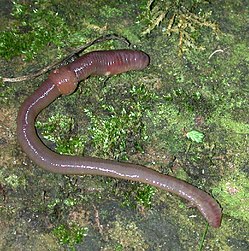
European Earthworm- This introduced species has voraciously spread throughout North American forests. It would thrive in the woodland habitat of our site, because it relies upon dead organic material above the soil for food. The large amounts of leaf litter would be perfect for it. When we dug our soil pit we saw this species.
Monday, October 22, 2012
Volume of Wood in board feet
The volume in board feet is the usable amount of timber in a tree.
* the formula
is [(½ DBH)2 x
Π] x height = board feet
Using the information about the eastern white pine which was our most common species we can determine the the density of eastern white pine is approximately 660 stems/hectare.

Species
|
Diameter at Breast height (cm)
|
Usable Height (ft)
|
Volume in board feet (ft)
|
PLOT
1
|
|||
sugar maple
|
10
|
37
|
2,904.5
|
chestnut oak
|
35
|
33
|
30,742.8
|
eastern white pine
|
28.5
|
37.5
|
23,910
|
eastern white pine
|
35.5
|
45
|
44,518.5
|
sugar maple
|
19.5
|
27
|
8,059.5
|
northern white cedar
|
20.5
|
22.5
|
7,422.8
|
sugar maple
|
12
|
18.3
|
2,067.9
|
hophornbeam (ironwood)
|
13
|
18
|
2,388.6
|
PLOT
2
|
|||
white birch
|
22
|
27
|
10,257.3
|
hophornbeam (ironwood)
|
12
|
22.5
|
2,542.5
|
PLOT
3
|
|||
eastern white pine
|
37
|
75
|
80,602.5
|
eastern white pin
|
24
|
60
|
27,132
|
PLOT 4
|
|||
sugar maple
|
12
|
24
|
2,712
|
sugar maple
|
8
|
18
|
903.6
|
PLOT
5
|
|||
eastern white pine
|
58
|
80
|
211,256
|
Sunday, October 14, 2012
Diameter Breast Height (DBH)
3.5 3 3.1 4.5 2.1 3.3 5.5 1.3 1.0 3.0 2.0 1.4 .9 3.4 4.2 5.4 2.1 3.2 4.6 3.3 2.7 2.2 1.1 1.4 3.2 4.1 4.0 5.1 7.5 5.4 5.9 8.1 6.4 5.5 4.2 3.0 1.0 2.5
Mean: 3.5
Median: 3.25
Top Diameter values in centimetres:
1.0 .7 .4 .8 2.3 2.5 4.9 6.5 2.1 2.3 3.5 2.1 2.5 7.0 9.5 2.1 4.5 4.4 3.5 3.5 9.5
Mean: 3.6
Median: 2.5
Although the average diameter values approximate 3.5cm, the median diameter values differ greatly between dead lumber located at the bottom and dead lumber at the top of a hill. The median diameter value was much higher at near the bottom of the hill. What could possibly explain this phenomenon? Obvious changes in acidity and nutrient content vary with changes in elevation. Due to gravity and the process of nutrient flow downhill, soils at the bottom of a hill are more abundant in nutrients than soils at the top of a hill. Trees at the bottom exposed to higher abundances of key nutrients, like phosphorus and nitrogen, will grow fatter. Trees at a higher slope, lacking key nutrients, will die sooner before they have the chance to grow large.
Friday, October 12, 2012
Wildlife Habitat features
|
Habitat Feature
|
Class
|
|
High exposed perches
|
Very apparent
|
|
Low exposed perches
|
Minimal
|
|
% canopy closure
|
>70%
|
|
Tree cavities (dbh)
|
There were no visible tree cavities
|
|
Midstory
|
Deciduous
|
|
Shrub layer
|
Deciduous
|
|
% ground vegetation
|
30-75%
|
|
Vernal pools/wetland vegetation
|
Minimal
|
|
Dead and downed material
|
Very apparent
|
|
Overstory inclusions
|
There were no overstory inclusions
|
|
Water body
|
There are no water bodies within our hectare
|
|
Proximity to water
|
About a quarter mile from Lake Champlain
|
|
Miscellaneous features
|
many ledges, potential den sites, hard mast, and hollow logs
|
The biggest tree on our site was an eastern white pine (Pinus strobus). It has a dbh of 58 cm, a height around 100 feet, and about 227 board feet.
The three most common tree species found in our hectare are sugar maple (Acer saccharum), eastern white pine (Pinus strobus), and hophornbeam aka ironwood (Ostrya virginiana).
There are a few spots that show evidence of human presence at one point in time. About a 1/3rd of the way up our hectare from the bottom of the hill are several patches of barbed wire poking up through the dead organic material layering the floor.
Friday, October 5, 2012
Forest Cover types
The forest cover types found at our plot are white pine-northern hardwood forest at the bottom, sugar maple-hophornbeam forest at the top. This site is representative of the surrounding forest because it made up of a mix of terrain that makes of the broad area around Niquette bay.

Friday, September 28, 2012
Bedrock and Surficial geology
The bedrock for site 10 was a mix of Dunham dolostone and limestone, (the green on the image below is Dunham dolostone) which was exposed to the surface on the top half of our hectare. The dolostone was smoother then the limestone and a was a dark grey color and reacted slightly in the hydrochloric acid test. The limestone was a rough white rock that appeared very similar to concrete and reacted strongly to the HCl test.

The loam for site 10 was FaE Farmington extremely rocky loam at a roughly 40% slope. We had a very thin layer of organic material before we hit the parent material, which was about a foot deep, and then we hit bedrock. The soil had a small amount of clay in it which allowed it to form slight ridges in your hand if you rolled it between your fingers. The soil had a pH of 7.5 which is slightly basic and explained why most of the trees were birch and other hardwood trees, such as this hornbeam otherwise known as musclewood.
The loam for site 10 was FaE Farmington extremely rocky loam at a roughly 40% slope. We had a very thin layer of organic material before we hit the parent material, which was about a foot deep, and then we hit bedrock. The soil had a small amount of clay in it which allowed it to form slight ridges in your hand if you rolled it between your fingers. The soil had a pH of 7.5 which is slightly basic and explained why most of the trees were birch and other hardwood trees, such as this hornbeam otherwise known as musclewood.

Subscribe to:
Posts (Atom)